
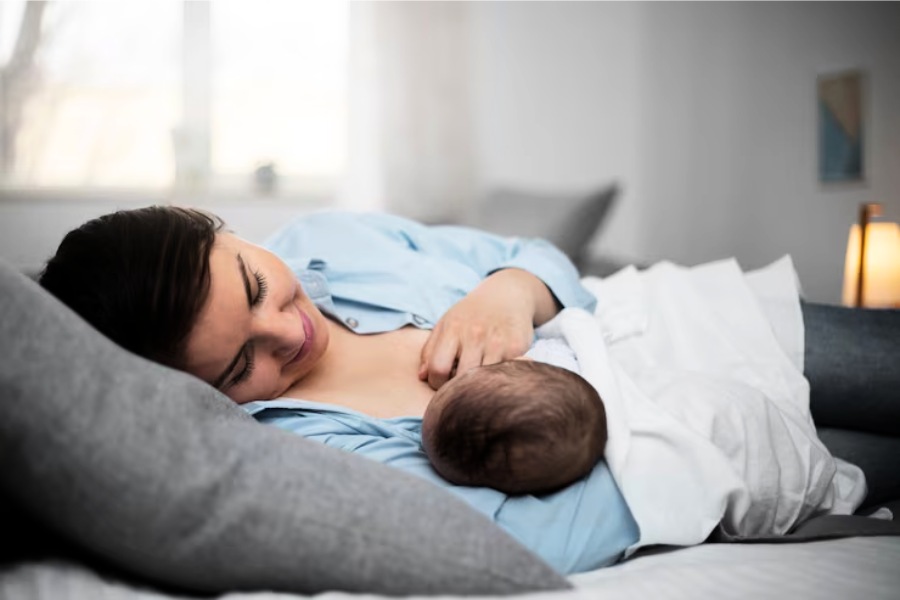
Amazed?
So was I, when I first time read about it.
Most of us strongly believe that after CS, a mother can’t breastfed its baby for first 12, 24 or 48
hours. We have often felt that it is not possible to breastfeed baby as
✦ “mother is NPO/NBM”
✦ “mother has pain that will not allow milk to
be produced”
✦ “ she can’t sit up to feed the baby”
✦ “milk comes after 48 hours only”
We as doctors nurture several myths, as our own experience, our logical understanding, our so called common sense or our “practical approach”. The more is the seniority, more are the myths.
Although all of us know that physiology does not support our “understanding”.
Essentially cesarean section or incision does not disturb breast or its hormonal sources. We know that milk production and its secretion depends on interplay of hormones namely prolactin, oxytocin, oestrogen & progesterone. Breasts start producing some amount of milk at 5 months gestation & go on growing capacity to produce milk. Placental hormones inhibit milk production before birth. Immediately after birth as placenta is delivered, the high levels of oestrogen drop drastically, allowing prolactin to stimulate milk secretion & oxytocin causing ejection. Then onwards as the baby sucks, milk “comes” (Contrarily to popular misbelief – after the milk comes, baby should be fed). & that is nature’s design. omething like you start eating a JALEBI & your salivary secretion starts. It then goes on till you continue eating.
But then what about our marking that initial days really there is no much milk production in a mother with pain & is NBM? On expression, the amount is hardly few drops. Won’t baby cry if it does not get sufficient milk? Won’t it develop hypoglycemia or jaundice? Won’t it loose excess weight & develop dehydration? Who will be responsible then?
Most of mammals after delivery hardly move for initial few days, allowing babies to suckle liberally. Also, they may not eat or drink for first few days. The fact is, breast secretion does not reduce unless mother ets severe dehydration. Besides, an NBM human mother is on IV fluids.
Analgesics are usually administered as a routine or on demand to alleviate pain. Breast feeding per se (suckling at breast) induces secretion of prolactin & endorphins that cause relaxation & analgesia to mother.
Expression of milk if mimics baby’s suckling, required amount can be collected. It has to be gentle, gradual & emotionally supportive. This distrustful maneuverer is best avoided as it often reduces mother’s confidence.
In the initial days the baby with small stomach capacity needs less amount more frequently. The colostrum is concentrated feed & provides the needed energy. It is secreted as demanded. Something like our salivary glands. When we eat, saliva is actively secreted rather than stored after last meal & released with food. Earlier & more the baby suckles, more is secretion & more is the mother relaxed.
The query remains, she can not sit up to feed, then?
Well, she can not sit up of day 1 or 2 after CS & she does not need to. Feeding in lying down position – mother lying supine & baby prone on the mother’s body is easiest way to feed the baby in the initial days as well as later. Without worrying for aspiration or otitis media. As we know, even when mom sits & breastfeeds, baby is suckling while in lying down position only. In fact mom can continue feeding in lying down position in initial one or two months, as long as she feels to rest. This drastically reduces lower backache a common compliant after CS.
Will the milk be sufficient?
A cat having 4 kittens produce milk for 4. One having 2 kittens will produce milk to 2. Nature has designed breasts in a way, that they produce milk on demand. More the baby extracts milk from breast, more will be produced. The production is ongoing even while the baby is actually feeding.Cesarean per se has no direct impact on the production.
Most of our perceptions of low milk production after cesarean are our mindsets, limitations within. Our eyes see what our brain knows (believes).
If a baby keeps on crying & does not suckle at breast especially after cesarean, we declare, “milk is less, baby has to be given “top” milk. We conveniently forget that NBM post surgical babies are often kept calm for hours with help of pacifiers without a single drop of milk. Babies cry if there is no good grip, not because there is no drip.
So with full confidence in a sympathetic way, all the mother should be encouraged for earliest (with in 1st hour) skin-to-skin contact & breast suckling liberally.
Early skin-to-skin contact between mother & baby [BREAST CRAWL] is a phenomenon that increases chances of exclusive breast feeding till 6 months & weaning at or after 2 years Antenatal counselling & intra-post natal support are most effective measures to ensure exclusive breast feeding & related advantages to baby, mother, family, obstetrician & nation.